

Critical Shoulder Angle Measurement Accuracy in Magnetic Resonance Imaging versus Radiographs: A retrospective cross-sectional study
Submission Type:Original Research Article
Authors
1 King Saud Medical City, Riyadh, Saudi Arabia
 DOI
DOIAbstract
Background: The Critical Shoulder Angle (CSA) is a radiographic measurement that has proven valuable in assessing shoulder pathologies such as osteoarthritis and rotator cuff tears. Despite its clinical utility, the consistency of CSA measurements across different imaging modalities, particularly magnetic resonance imaging (MRI) versus radiographs, remains debated.
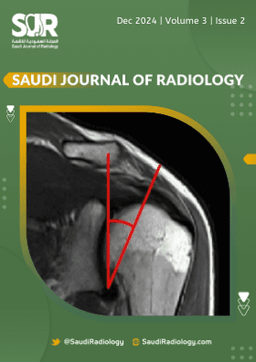
Objective: This retrospective cross-sectional study aims to assess the accuracy and reliability of CSA measurements obtained from routine shoulder MRI compared to standard radiography.
Methods: A total of 210 patients with both coronal oblique MRI images and true anteroposterior (AP) radiographs of the shoulder were included in the study. CSA measurements were independently performed by two observers using a standardized method, and inter- and intra-observer agreement was evaluated. Statistical analyses were conducted to determine differences in CSA measurements between the two modalities and assess agreement levels.
Results: The mean CSA measured on radiographs (33.7 ± 4.4) was significantly higher than that on MRI (32.8 ± 4.06, p=0.04). Inter- and intra-observer agreements were higher for radiographic measurements (ICC > 0.95) compared to MRI, where variability was noted, particularly concerning gender differences. CSA values showed no significant differences based on shoulder side (right vs. left) in either modality.
Conclusion: CSA measurements were more accurate and consistent on radiographs than MRI, suggesting that radiography remains the preferred modality for assessing CSA in clinical settings. The study highlights the need for standardized imaging techniques to improve measurement consistency across modalities.
Main Subjects
Keywords

References
- 1.Gumina S, Polizzotti G, Spagnoli A, Carbone S, Candela V. Critical shoulder angle (CSA): age and gender distribution in the general population. Journal of Orthopaedics and Traumatology. 2022 Dec;23(1):10.
- 2.[Gulcu, A., Aslan, A., Dincer, R., Özmanevra, R., & Huri, G. (2022). Relationship Between Diagnostic Anatomic Shoulder Parameters and Degenerative Rotator Cuff Tears: An MRI Study. Orthopaedic journal of sports medicine, 10(11), 23259671221130692. https://doi.org/10.1177/23259671221130692
- 3.Jäschke, M., Köhler, H. C., Weber, M. A., Tischer, T., Hacke, C., & Schulze, C. (2023). Subacromial impingement syndrome: association of multiple magnetic resonance imaging parameters with shoulder function and pain. Archives of orthopaedic and trauma surgery, 143(1), 237–246. https://doi.org/10.1007/s00402- 021-04032-6
- 4.Yıldız, A. E., Yaraşır, Y., Huri, G., & Aydıngöz, Ü. (2022). Optimization of the Grashey View Radiograph for Critical Shoulder Angle Measurement: A Reliability Assessment With Zero Echo Time MRI. Orthopaedic journal of sports medicine, 10(8), 23259671221109522.
- 5.Herve, A., Thomazeau, H., Favard, L., Colmar, M., Mansat, P., Walch, G., Betz, M., Kempf, J. F., & Collin, P. (2019). Clinical and radiological outcomes of osteoarthritis twenty years after rotator cuff repair. Orthopaedics & traumatology, surgery & research: OTSR, 105(5), 813–818. https://doi.org/10.1016/j.otsr.2019.02.013
- 6.Moor, B. K., Bouaicha, S., Rothenfluh, D. A., Sukthankar, A., & Gerber, C. (2013). Is there an association between the individual anatomy of the scapula and the development of rotator cuff tears or osteoarthritis of the glenohumeral joint?: A radiological study of the critical shoulder angle. The bone & joint journal, 95-B(7), 935–941.https://doi.org/10.1302/0301-620X.95B7.31028
- 7.Heuberer, P. R., Plachel, F., Willinger, L., Moroder, P., Laky, B., Pauzenberger, L., Lomoschitz, F., & Anderl, W. (2017). Critical shoulder angle combined with age predict five shoulder pathologies: a retrospective analysis of 1000 cases. BMC musculoskeletal disorders, 18(1), 259. https://doi.org/10.1186/s12891-017-1559-4
- 8.Rose-Reneau, Z., Moorefield, A. K., Schirmer, D., Ismailov, E., Downing, R., & Wright, B. W. (2020). The Critical Shoulder Angle as a Diagnostic Measure for Osteoarthritis and Rotator Cuff Pathology. Cureus, 12(11), e11447. https://doi.org/10.7759/cureus.11447
- 9.Kuper, G., Shanmugaraj, A., Horner, N. S., Ekhtiari, S., Simunovic, N., Cadet, E. R., & Ayeni, O. R. (2019). Critical shoulder angle is an effective radiographic parameter that is associated with rotator cuff tears and osteoarthritis: a systematic review. Journal of ISAKOS, 4(2), 113-120.
- 10.Bouaicha, S., Ehrmann, C., Slankamenac, K., Regan, W. D., & Moor, B. K. (2014). Comparison of the critical shoulder angle in radiographs and computed tomography. Skeletal radiology, 43(8), 1053–1056. https://doi.org/10.1007/s00256-014-1888-4
- 11.Loriaud A, Bise S, Meyer P, Billaud A, Dallaudiere B, Silvestre A, Pesquer L. Critical shoulder angle: what do radiologists need to know?. Skeletal Radiology. 2020 Apr;49:515-20.
- 12.Spiegl UJ, Horan MP, Smith SW, Ho CP, Millett PJ. The critical shoulder angle is associated with rotator cuff tears and shoulder osteoarthritis and is better assessed with radiographs over MRI. Knee Surgery, Sports Traumatology, Arthroscopy. 2016 Jul;24:2244-51.
- 13.Vilela, J. C. S., Vidal, A. L. A., Correa, M. A., de Andrade, L. M., Ribeiro, P. H. S., de Araúj, B. B. T. F., ... & Machado, T. L. A. (2022). Critical Shoulder Angle Assessment in Radiographies and Magnetic Resonance Imaging (MRI): Measurement of Intra and Inter-Observer Agreement. Medical Research Archives, 10(4).
- 14.Hoessly M, Bouaicha S, Jentzsch T, Meyer DC. Angle of approach to the superior rotator cuff of arthroscopic instruments depends on the acromial morphology: an experimental study in 3D printed human shoulders. Journal of orthopaedic surgery and research. 2019 Dec;14:1-8.
- 15.Suter, T., Gerber Popp, A., Zhang, Y., Zhang, C., Tashjian, R. Z., & Henninger, H. B. (2015). The influence of radiographic viewing perspective and demographics on the critical shoulder angle. Journal of shoulder and elbow surgery, 24(6), e149–e158. https://doi.org/10.1016/j.jse.2014.10.021
- 16.[16] Couppé, C., Svensson, R. B., Sødring-Elbrønd, V., Hansen, P., Kjaer, M., & Magnusson, S. P. (2014). Accuracy of MRI technique in measuring tendon cross- sectional area. Clinical Physiology and Functional Imaging, 34(3), 237-241
- 17.[17] Shibayama, Y., Imamura, R., Hirose, T., Sugi, A., Mizushima, E., Watanabe, Y., Tomii, R., Emori, M., Teramoto, A., Iba, K., & Yamashita, T. (2023). Reliability and accuracy of the critical shoulder angle measured by anteroposterior radiographs: using digitally reconstructed radiograph from 3-D CT images. Journal of shoulder and elbow surgery, 32(2), 286–291. https://doi.org/10.1016/j.jse.2022.07.017
- 18.Long Y, Hu H, Zhou C, Hou J, Wang Z, Zhou M, Cui D, Xu X, Yang R. The Critical Shoulder Angle Can be Accurately and Reliably Determined from 3-D CT Images. Orthopaedic Surgery. 2023 Jan 20.
- 19.Schiefer, M., Naliato, E., Oliveira, R., Carmo, L. T. D., Fontenelle, C. R. D. C., & Motta Filho, G. D. R. (2023). MRI is a Reliable Method for Measurement of Critical Shoulder Angle and Acromial Index. Revista brasileira de ortopedia, 58(5), e719– e726. https://doi.org/10.1055/s-0043-1776136
- 20.Yu, M., Zhu, X., Zhang, Y., Guo, L., Li, D., Tian, F., An, N., Hao, R., & Wang, C. (2021). Correlation of Multiple Acromion Morphological Parameters on Radiographs in a Geriatric Chinese Population and Its Clinical Significance. Geriatric orthopaedic surgery & rehabilitation, 12, 21514593211043990. https://doi.org/10.1177/21514593211043990
- 21.Shenton D. W. (2020). Editorial Commentary: It's Déjà Vu All Over Again: Critical Shoulder Angle X-ray Measurements Do Correlate With Disease if the X-rays Are Carefully Taken. the journal of arthroscopic & related surgery, 36(2), 576–578. https://doi.org/10.1016/j.arthro.2019.11.106
- 22.Vellingiri, K., Ethiraj, P., & Shanthappa, A. H. (2020). Critical Shoulder Angle and Its Clinical Correlation in Shoulder Pain. Cureus, 12(8), e9810. https://doi.org/10.7759/cureus.9810
- 23.Kim, D. H., Choi, H. U., Choi, B. C., Kim, J. H., & Cho, C. H. (2022). Postoperative acromiohumeral interval affects shoulder range of motions following reverse total shoulder arthroplasty. Scientific reports, 12(1),21011.https://doi.org/10.1038/s41598-022-25173-7
- 24.Passaplan, C., Hasler, A., & Gerber, C. (2021). The critical shoulder angle does not change over time: a radiographic study. Journal of shoulder and elbow surgery, 30(8), 1866–1872. https://doi.org/10.1016/j.jse.2020.09.042
- 25.Garcia, J. C., Altoe, L. S., do Amaral, R. F. M., Aihara, A. Y., Lutfi, H. V., & Mello, M. B. D. (2021). Double-Blinded Randomized Study of the Correlation between Simple Radiography and Magnetic Resonance Imaging in the Evaluation of the Critical Shoulder Angle: Reproducibility and Learning Curve. Revista brasileira de ortopedia, 56(1), 78–82. https://doi.org/10.1055/s-0040-1701288
- 26.[26] Lin, C. L., Chen, Y. W., Lin, L. F., Chen, C. P., Liou, T. H., & Huang, S. W. (2020). Accuracy of the critical shoulder angle for predicting rotator cuff tears in patients with nontraumatic shoulder pain. Orthopaedic journal of sports medicine, 8(5), 2325967120918995.
- 27.Tang, Y., Hou, J., Li, Q., Li, F., Zhang, C., Li, W., & Yang, R. (2019). The effectiveness of using the critical shoulder angle and acromion index for predicting rotator cuff tears: accurate diagnosis based on standard and nonstandard anteroposterior radiographs. Arthroscopy: The Journal of Arthroscopic & Related Surgery, 35(9), 2553-2561.
- 28.Song, J. G., Yun, S. J., Song, Y. W., & Lee, S. H. (2019). High performance of critical shoulder angle for diagnosing rotator cuff tears on radiographs. Knee Surgery, Sports Traumatology, Arthroscopy, 27, 289-298.
- 29.Rhee, S. M., Kim, J. Y., Kim, J. Y., Cho, S. J., Kim, J. H., & Rhee, Y. G. (2019). The critical shoulder angle: can it be sufficient to reflect the shoulder joint without the humeral head?. Journal of Shoulder and Elbow Surgery, 28(4), 731-741.
- 30.Kim, J. H., Gwak, H. C., Kim, C. W., Lee, C. R., Kwon, Y. U., & Seo, H. W. (2019). Difference of critical shoulder angle (CSA) according to minimal rotation: can minimal rotation of the scapula be allowed in the evaluation of CSA?. Clinics in orthopedic surgery, 11(3), 309.
- 31.Candan, B., Torun, E., Dikici, R., Avnioglu, S. and Gunal, M.Y. (2023). Correlation of some anatomical angles of the shoulder with rotator cuff syndrome. Journal of the Anatomical Society of India, 72(1), pp.22-28. doi: 10.4103/jasi.jasi_186_21
- 32.[Feuerriegel, G. C., Kopp, F. K., Pfeiffer, D., Pogorzelski, J., Wurm, M., Leonhardt, Y., ... & Gersing, A. S. (2022). Evaluation of MR-derived simulated CT-like images and simulated radiographs compared to conventional radiography in patients with shoulder pain: a proof-of-concept study. BMC Musculoskeletal Disorders, 23(1), 122.